| B i o g r a p h y |
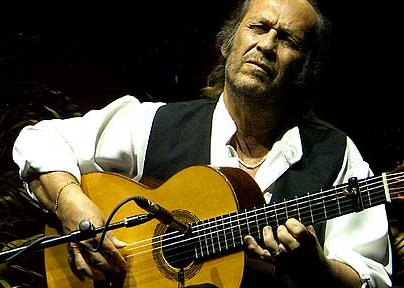 Paco de Lucía was a pseudonym of Francisco Sánchez Gómez
(born on 21 December 1947 in Algeciras, Cádiz, Spain - died on 26
Februray 2014, Mexico). He was considered a master of rasgueados /
picados and was capable of playing with blinding speed on the flamenco
guitar.
Paco de Lucía was a pseudonym of Francisco Sánchez Gómez
(born on 21 December 1947 in Algeciras, Cádiz, Spain - died on 26
Februray 2014, Mexico). He was considered a master of rasgueados /
picados and was capable of playing with blinding speed on the flamenco
guitar.
He was the youngest of five children, the son of flamenco guitarist
Antonio Sánchez, and brother of flamenco singer Pepe de Lucía and
flamenco guitarist Ramón de Algeciras, he adopted the stage name Paco de
Lucía in honor of his Portuguese mother, Lucía Gomes.
In 1958, at age 11, de Lucía made his first public appearance on Radio
Algeciras, and a year later he was awarded a special prize in the Jerez
flamenco competition. In 1961, he toured with the flamenco troupe of
dancer José Greco. In 1964, de Lucía met Madrilenian guitarist Ricardo
Modrego with whom he recorded three albums: Dos guitarras flamencas, Dos
Guitarras Flamencas En Stereo, and 12 Canciones De Garcia Lorca Para
Guitarra. Between 1968 and 1977, he enjoyed a fruitful collaboration
with fellow New Flamenco innovator Camarón de la Isla. The two recorded
10 albums together.
In 1979, de Lucía, John McLaughlin and Larry Coryell formed “The Guitar
Trio” and together made a brief tour of Europe and released a video
recorded at London’s Royal Albert Hall entitled Meeting of Spirits.
Coryell was later replaced by Al Di Meola, and since 1981, the trio have
recorded three albums under that line-up. His own band, the Paco de
Lucía Sextet (which includes his brothers Ramón and Pepe) released the
first of their three albums that same year. He has released several
albums encompassing both traditional and modern flamenco styles. Through
his wide discography he has given rise to a new way of understanding
flamenco and has advanced the technical and musical boundaries of his
instrument. The University of Cadiz recognized de Lucía’s musical and
cultural contributions by conferring on him the title of Doctor Honoris
Causa on March 23, 2007.
Until asked to perform and interpret Joaquín Rodrigo’s Concierto de
Aranjuez in 1991, de Lucía was not proficient at reading musical
notation. As a flamenco guitarist, de Lucía claimed in Paco de Lucía.
Light and Shade: A Portrait that he gave greater emphasis to rhythmical
accuracy in his interpretation of the Concierto at the expense of the
perfect tone preferred by classical guitarists. Joaquín Rodrigo declared
that no one had ever played his composition in such a brilliant manner.
Paco de Lucía died on 26 Feb 2014 due to a heart attack. He was 66 years old.
Official site: www.pacodelucia.org