| B i o g r a p h y |
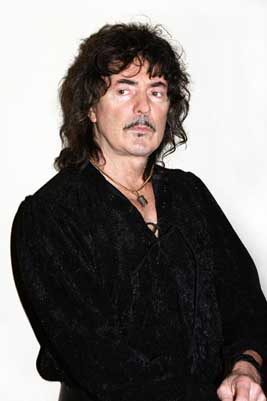 Some
people seem as if they were born to be great players. The minute an
instrument is thrust into their fledgling hands, they take to it like a
second skin, shedding the darkness of ignorance in favor of the light
of musical prowess. No so for Ritchie
Blackmore.
Although he had strong motivation to improve ("When I was eleven I had
an acoustic guitar, and my father threatened me with it. He said,
‘If you don’t learn this instrument, I’ll smash it
over your head!’"), his first few years were a struggle.
Classical lessons didn’t help much either.
Some
people seem as if they were born to be great players. The minute an
instrument is thrust into their fledgling hands, they take to it like a
second skin, shedding the darkness of ignorance in favor of the light
of musical prowess. No so for Ritchie
Blackmore.
Although he had strong motivation to improve ("When I was eleven I had
an acoustic guitar, and my father threatened me with it. He said,
‘If you don’t learn this instrument, I’ll smash it
over your head!’"), his first few years were a struggle.
Classical lessons didn’t help much either.But at 13, he was drawn to the fretting prowess of English artists like Hank Marvin of the Shadows, and Gene Vincent’s guitarist Cliff Gallup. American rockers Duane Eddy, Buddy Holly, and others also caught his ear. Hours spent learning their guitar parts paid off, and he began to get the hang of it. The real turning point, though, was his discovery of country pickers: Chet Atkins, Speedy West, Jimmy Bryant and their compatriots impressed young Blackmore with their speed and adept flatpicking techniques. He worked hard to develop the same qualities in his playing, and thus acquired much of the quick picking and double note riffing that characterizes his style to this day.
Although it still wasn’t easy, he worked hard, coming home from school as soon as possible and putting in up to eight hours of practice every day. He even slept with his guitar. "I didn’t know whether it was safer to keep the guitar in the bed or underneath it," Blackmore recalls. "Either way I was afraid I’d break the thing." By the time he reached 16, the devotion to and subsequent mastery of fast, complex riffing led to session work – often sharing studio dates with Jimmy Page – and stints with the theatrical rock group Screaming Lord Sutch. He eventually tired of session work and moved to Hamburg, playing with several bands, and meeting organist Jon Lord and drummer Ian Paice, with who he would form Deep Purple.
At first the band (which included bassist Nicky Simper) was fronted by lead singer Rod Evans. Their first album, Shades of Deep Purple, gave them a Top Five hit in the US in 1968: "Hush," a Joe South cover; they scored another US hit in 1969 with Neil Diamond’s "Kentucky Woman" from The Book of Taliesyn, released only in the States. Following their third album, Deep Purple, their American label folded and the group made the first of their many personnel changes. After seeing a young Robert Plant singing in a club, Blackmore decided, "We’ve got to have a singer who can compete with this guy," and Evans was replaced by Ian Gillan, while Simper was replaced by bassist Roger Glover. Following 1970’s Concerto for Group and Orchestra, the new lineup began moving away from the more classical organ sound of their early albums and towards a more guitar-driven, aggressive-vocals "metal’ sound, which was evident on their 1970 release, Deep Purple in Rock and 1971’s Fireball, both successful albums. It was 1972’s Machine Head that earned them their place in rock history, with the enduring hit "Smoke on the Water," as well as "Space Truckin’" and "Highway Star." Who Do We Think We Are in 1973 gave them the hit "Woman From Tokyo," but Gillan and Glover left the band, to be replaced by David Coverdale and Glenn Hughes for 1974’s Burn and Stormbringer.
In 1974, Blackmore left Deep Purple and formed Ritchie Blackmore’s Rainbow with a New York band called Elf and its lead singer, Ronnie James Dio. Deep Purple endured for another year or so before officially disbanding. For nearly ten years Rainbow was a fairly successful band, especially in the UK, and endured many personnel changes, but in 1983 Blackmore dissolved it to reform Deep Purple with Gillan, Glover, Paice and Lord, and they recorded their comeback album, Perfect Strangers, which went platinum. Blackmore continued with Deep Purple through several more albums, during which Gillan left and returned (replaced by Rainbow’s Joe Lyn Turner in the interim), but Ritchie left the group during the supporting tour for 1992’s The Battle Rages On…, citing displeasure with Gillan’s performance. Following his second departure from Deep Purple, Blackmore reformed Rainbow in 1994, recording and touring with them throughout 1995, 1996 and 1997.
In ’96 he began moving in a new direction, without Rainbow. Teaming up with vocalist and lyricist Candice Night, they released the acoustic Renaissance album Shadow of the Moon as Blackmore’s Night, and followed it up in 1999 with Under a Violet Moon and 2001’s Fires at Midnight. Taking a decidedly different turn from the usual rock tour, Blackmore’s Night has instead undertaken "castle tours" of Europe, in which they play special evenings in medieval and Renaissance castles, as well as fairs and smaller venues.
* * *
 Blackmore's Night is a British/American traditional folk rock duo formed in 1997, consisting of Ritchie Blackmore (acoustic and electric guitar) and Candice Night
(lead vocals, lyricist and multi-instrumentalist). To date they have
released ten studio albums; their latest, All Our Yesterdays, was
released on September 18, 2015.
Blackmore's Night is a British/American traditional folk rock duo formed in 1997, consisting of Ritchie Blackmore (acoustic and electric guitar) and Candice Night
(lead vocals, lyricist and multi-instrumentalist). To date they have
released ten studio albums; their latest, All Our Yesterdays, was
released on September 18, 2015.
Candice was a Rainbow fan, and first encountered Ritchie Blackmore to ask him for an autograph in 1989, while she was working for a local New York radio station. The two started living together in 1991, and discovered they both had a passionate interest in Renaissance music. During the reformed Rainbow's recording of the album Stranger in Us All in 1995, on which Night contributed some of the lyrics and backing harmony vocals, the duo were already gearing up their debut album. Night's personality and singing ability made her the natural choice as frontwoman. In 1997 the project started as being a pun of their own names, which would consist of themselves plus session musicians.
Their debut album Shadow of the Moon was a musical success and featured Ian Anderson of Jethro Tull on flute for the song "Play Minstrel Play". In subsequent albums, particularly Fires at Midnight, there was an increased incorporation of rock guitar into the music, whilst maintaining a folk rock direction. Over time, Night has increasingly participated instrumentally as well as singing the vocals, and is competent in a wide variety of Renaissance instruments. The group performs at Renaissance Faires and Renaissance Festivals, as well as in stand-alone concert tours in appropriate venues including 'castle tours' of Europe, where they perform in historic surroundings for an audience dressed largely in period costume. The duo has been successful enough to inspire a number of international tribute bands including: Renaissance Night, the Italian Morning Star and the Midnight. They have also performed the music for MagiQuest, a live simulation game.
In 2006, Night performed a duet with Andi Deris on Helloween's "Light the Universe", which was released as a single in certain countries and is available on their album Keeper of the Seven Keys: The Legacy, released in the same year. On June 27, 2008, the duo released its seventh studio album called Secret Voyage, a mix of medieval-sounding tracks and some contemporary ones. In addition to some covers of some traditional folk music (“Locked Within the Crystal Ball" is from the fourteenth century) and some originals, Blackmore’s Night also performed a cover of a Rainbow song (“Rainbow Eyes”) and an Elvis Presley cover ("Can't Help Falling in Love"). On October 5, 2008, Night and Blackmore were married after 19 years together. This is the fourth marriage for Blackmore. Autumn Esmerelda Blackmore was born on May 27, 2010. A new album titled Autumn Sky was released soon afterwards. Their son Rory Dartanyan was born on February 7, 2012.